
From BizDom Blog
Usain Bolt signs sponsorship deal with Hublot
Herbalife Becomes New Sponsor of FC Barcelona

Herbalife Ltd. announced a three-year, multi-million dollar agreement with FC Barcelona to make Herbalife the club's Official Nutrition Sponsor. At the same time, Leo Messi has agreed to a personal sponsorship agreement.
Alpenliebe’s new TVC
Alpenlibe's new TVC has got monkeys in place of crocodile but there is a twist in ad.
AQAD 64
Forward this gentleman's name & company with which he is associated to bizdomonline@gmail.com

Tracking the Video Game Companies

Rare, Ltd. which was formerly known as Rareware is a British video game development company. It was founded in 1982 by brothers Tim and Chris Stamper as Ashby Computers and Graphics Ltd. (ACG). In 2002, Rare was acquired by Microsoft.
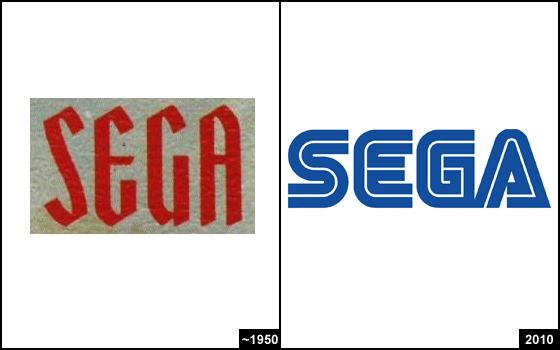
Sega was founded in 1940 as Standard Games (later Service Games) in Honolulu, Hawaii, United States, by Marty Bromely, Irving Bromberg, and James Humpert to provide coin-operated amusements for American servicemen on military bases. Bromely suggested that the company move to Tokyo, Japan in 1951 and in May 1952 "SErvice GAmes of Japan" was registered.
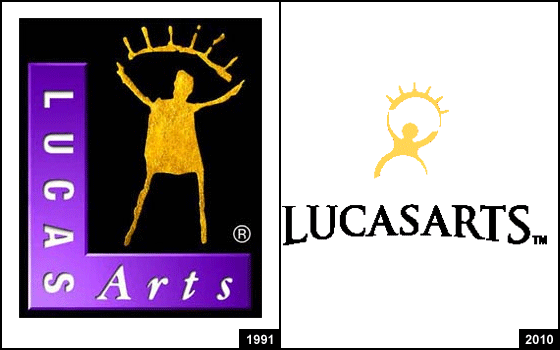
3. LucasArts
The company was founded in May 1982 as the video game development group of Lucasfilm Limited, the film production company of George Lucas. Lucas had wanted his company to branch out into other areas of entertainment, and so he cooperated with Atari to produce video games.
The original Lucasfilm Games logo was based upon the existing Lucasfilm movie logo. There were a number of variations on it.
The original Lucasfilm Games logo was based upon the existing Lucasfilm movie logo. There were a number of variations on it.
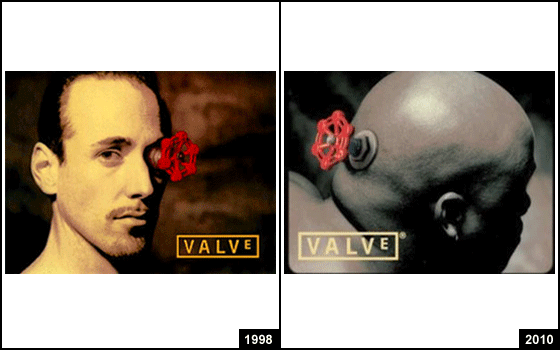
4. Valve
Valve Corporation is an American video game development and digital distribution company based in Bellevue, Washington, USA that was founded in 1996, and made famous by its first product, Half-Life, which was released in November 1998, and by its distribution software, Steam.
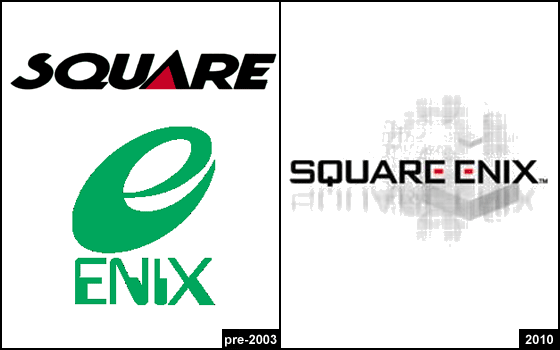
5. Square-Enix
Square Enix was formed as the result of a merger between Square Co. and the Enix Corporation.
When Square and Enix merged in ‘03, Square’s color scheme won the day. Here’s hoping the castle in the background is some sort of EarthBound revival clue that no one’s yet decoded.
When Square and Enix merged in ‘03, Square’s color scheme won the day. Here’s hoping the castle in the background is some sort of EarthBound revival clue that no one’s yet decoded.
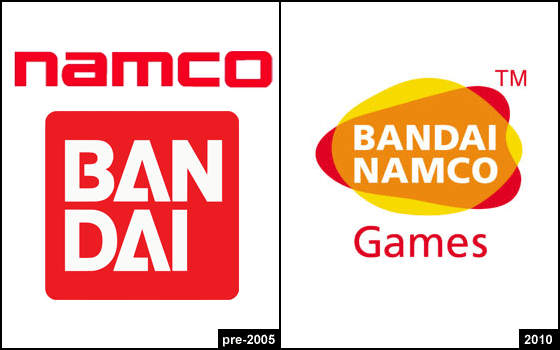
6. Namco-Bandai
Bandai Namco Group, is a Japanese holding company formed from the merger of Namco and Bandai.
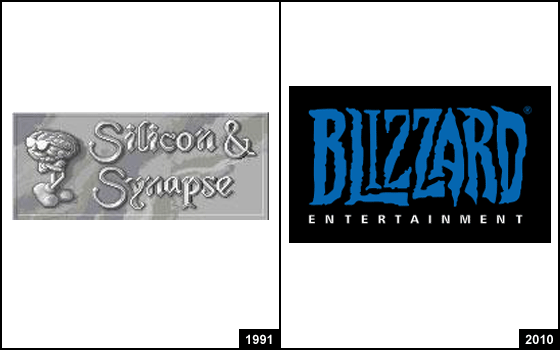
7. Blizzard
Blizzard used to be called “Silicon & Synapse” and have a grumpy, anthropomorphic brain wearing shoes as its mascot. But its current logo is still pretty old-school: It’s been basically unchanged since 1994.
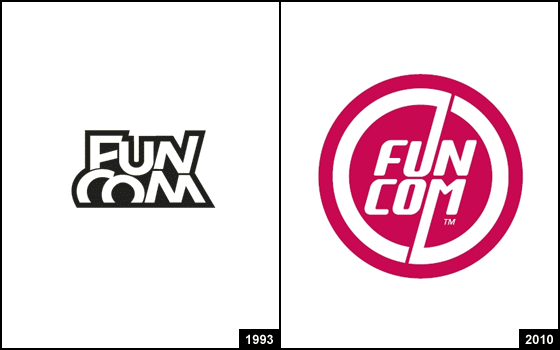
8. Funcom
Founded in 1993 by Erik Gloersen, Ian Neil, Andre Backen, Gaute Godager and Olav Mørkrid. It is best known for the Massively Multiplayer Online Roleplaying Game (MMORPG) titles Age of Conan, Anarchy Online, and its The Longest Journey series of adventure games.
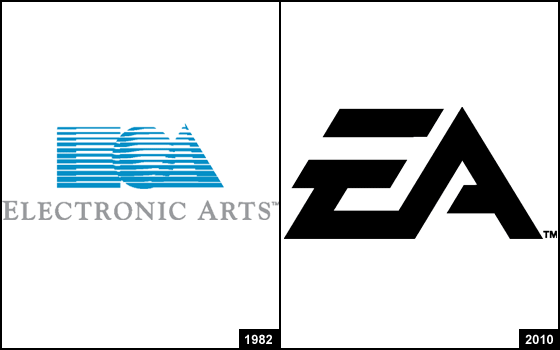
9. EA
Founded and incorporated on May 28, 1982 by Trip Hawkins, the company was a pioneer of the early home computer games industry and was notable for promoting the designers and programmers responsible for its games.
EA’s old logo confused people. “Many customers mistook the square/circle/triangle logo for a stylized “EOA.” Though they thought the “E” stood for “Electronic” and “A” for “Arts”, they had no idea what the “O” could stand for, except perhaps the o in “Electronic.”
EA’s old logo confused people. “Many customers mistook the square/circle/triangle logo for a stylized “EOA.” Though they thought the “E” stood for “Electronic” and “A” for “Arts”, they had no idea what the “O” could stand for, except perhaps the o in “Electronic.”
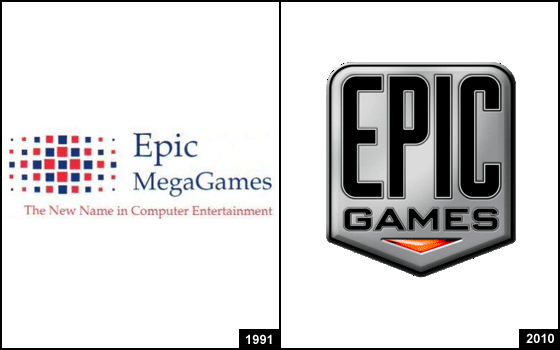
10. Epic Games
Epic Games was initially founded under the name of 'Potomac Computer Systems' in 1991 by Tim Sweeney in Rockville, Maryland, releasing its flagship product, ZZT, the same year. During the latter portion of ZZT's life span, the company became known as Epic MegaGames and subsequently released numerous popular shareware games.
Back when it was called “Epic MegaGames,” Epic’s logo definitely had swagger, declaring itself “the new name in computer entertainment” with a decidedly ’90s box array; today, it rocks a badge that isn’t out of place alongside the shooters and action games that are its trademark.
Back when it was called “Epic MegaGames,” Epic’s logo definitely had swagger, declaring itself “the new name in computer entertainment” with a decidedly ’90s box array; today, it rocks a badge that isn’t out of place alongside the shooters and action games that are its trademark.
11. THQ
Trinity Acquisition Corporation was founded in 1989. In 1991, it merged with T*HQ (Toy Head-Quarters), a toy manufacurer and video game company founded around the same time as Trinity Acquisition. The combined company initially adopted the name T*HQ but was eventually renamed to THQ in the mid-1990s
12. SNK
SNK Playmore Corporation is a Japanese video game hardware and software company. SNK is an acronym of Shin Nihon Kikaku, Japanese for "New Japan Project", which was SNK's original name. The company's legal and trading name became SNK in 1986.The original SNK was founded in Osaka, Japan, in July 1978 by Eikichi Kawasaki, and existed until October 22, 2001. Anticipating the end of his first company, Kawasaki founded the company Playmore in August 2001, which in 2003 became SNK Playmore.
13. Bethesda
Founded in 1986 by Christopher Weaver in Bethesda, Maryland and moved to Rockville, Maryland in 1990
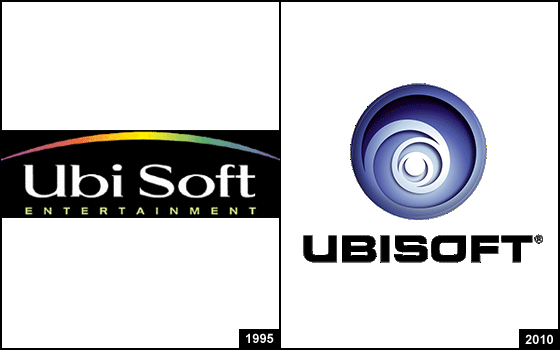
14. Ubisoft
The five brothers of the Guillemot family founded Ubisoft as a computer game publisher in 1986 in France (Brittany).
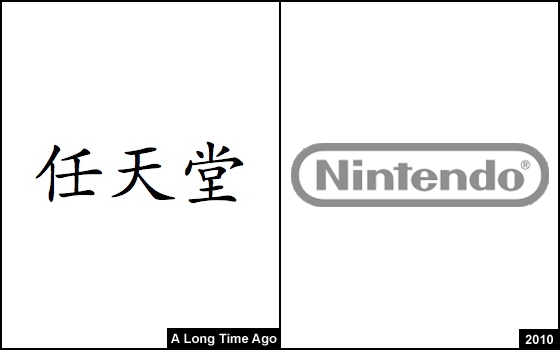
15. Nintendo
Founded on September 23, 1889 by Fusajiro Yamauchi, it produced handmade hanafuda cards. By 1963, the company had tried several small niche businesses, such as a cab company and a love hotel. It was originally named Nintendo Koppai. The name "Nintendo" translated from Japanese to English means "Leave luck to Heaven"
World's Hottest Brands

If the coach goes naked, we will, too. Pepsi promises.
Diego Maradona, the coach for Argentina’s football team recently stated that he will run the streets of Buenos Aires undressed if his team becomes a champion. Now Pepsi-Argentina has launch a campaign model on this promise
 PepsiCo announced that the soft drink will be sold with no label for a week in Argentina if that country wins the football tournament. BBDO Argentina created print ads for the company illustrating what the un-labeled bottles will look like with only a blue label around the neck of the bottle stating, “If the coach goes naked, we will, too. Pepsi promises.”
 PepsiCo announced that the soft drink will be sold with no label for a week in Argentina if that country wins the football tournament. BBDO Argentina created print ads for the company illustrating what the un-labeled bottles will look like with only a blue label around the neck of the bottle stating, “If the coach goes naked, we will, too. Pepsi promises.”

The Men Behind Liquors
Here’s some biographical detail on the men behind favorite tipples.
1. Captain Morgan
 The Captain wasn’t always just the choice of sorority girls looking to blend spiced rum with Diet Coke; in the 17th century he was a feared privateer. Not only did the Welsh pirate marry his own cousin, he ran risky missions for the governor of Jamaica, including capturing some Spanish prisoners in Cuba and sacking Port-au-Prince in Haiti. He then plundered the Cuban coast before holding for ransom the entire city of Portobelo, Panama. He later looted and burned Panama City, but his pillaging career came to an end when Spain and England signed a peace treaty in 1671. Instead of getting in trouble for his high-seas antics, Morgan received knighthood and became the lieutenant governor of Jamaica.
2. Johnnie Walker
 Walker, the name behind the world’s most popular brand of Scotch whisky, was born in 1805 in Ayrshire, Scotland. When his father died in 1819, Johnnie inherited a trust of a little over 400 pounds, which the trustees invested in a grocery store. Walker grew to become a very successful grocer in the town of Kilmarnock and even sold a whisky, Walker’s Kilmarnock Whisky. Johnnie’s son Alexander was the one who actually turned the family into famous whisky men, though. Alexander had spent time in Glasgow learning how to blend teas, but he eventually returned to Kilmarnock to take over the grocery from his father. Alexander turned his blending expertise to whisky, and came up with “Old Highland Whisky,” which later became Johnnie Walker Black Label.
3. Jack Daniel
 Jasper Newton “Jack” Daniel of Tennessee whiskey fame was the descendant of Welsh settlers who came to the United States in the early 19th century. He was born in 1846 or 1850 and was one of 13 children. By 1866 he was distilling whiskey in Lynchburg, Tennessee. Unfortunately for the distiller, he had a bit of a temper. One morning in 1911 Daniel showed up for work early and couldn’t get his safe open. He flew off the handle and kicked the offending strongbox. The kick was so ferocious that Daniel injured his toe, which then became infected. The infection soon became the blood poisoning that killed the whiskey mogul.
Curious about why your bottle of J.D. also has Lem Motlow listed as the distillery’s proprietor? Daniel’s own busy life of distilling and safe-kicking kept him from ever finding a wife and siring an heir, so in 1907 he gave the distillery to his beloved nephew Lem Motlow, who had come to work for him as a bookkeeper.
4. Jose Cuervo
 In 1758, Jose Antonio de Cuervo received a land grant from the King of Spain to start an agave farm in the Jalisco region of Mexico. Jose used his agave plants to make mescal, a popular Mexican liquor. In 1795, King Carlos IV gave the land grant to Cuervo’s descendant Jose Maria Guadalupe de Cuervo. Carlos IV also granted the Cuervo family the first license to commercially make tequila, so they built a larger factory on the existing land. The family started packaging their wares in individual bottles in 1880, and in 1900 the booze started going by the brand name Jose Cuervo. The brand is still under the leadership of the original Jose Cuervo’s family; current boss Juan-Domingo Beckmann is the sixth generation of Cuervo ancestors to run the company.
5. Jim Beam
 Jim Beam, the namesake of the world’s best-selling bourbon whiskey, didn’t actually start the distillery that now bears his name. His great-grandfather Jacob Beam opened the distillery in 1788 and started selling his first barrels of whiskey in 1795. In those days, the whiskey went by the less-catchy moniker of “Old Tub.” Jacob Beam handed down the distillery to his son David Beam, who in turn passed it along to his son David M. Beam, who eventually handed the operation off to his son, Colonel James Beauregard Beam, in 1894. Although he was only 30 years old when he took over the family business, Jim Beam ran the distillery until Prohibition shut him down. Following repeal in 1933, Jim quickly built a distillery and began resurrecting the Old Tub brand, but he also added something new to the company’s portfolio: a bourbon simply called Jim Beam.
6. Tanqueray
 When he was a young boy, Charles Tanqueray’s path through life seemed pretty clear. He was the product of three straight generations of Bedfordshire clergymen, so it must have seemed natural to assume that he would take up the cloth himself. Wrong. Instead, he started distilling gin in 1830 in a little plant in London’s Bloomsbury district. By 1847, he was shipping his gin to colonies around the British Empire, where many plantation owners and troops had developed a taste for Tanqueray and tonic.
7. Campari
 Gaspare Campari found his calling quickly. By the time he was 14, he had risen to become a master drink mixer in Turin, and in this capacity he started dabbling with a recipe for an aperitif. When he eventually settled on the perfect mixture, his concoction had over 60 ingredients. In 1860, he founded Gruppo Campari to make his trademark bitters in Milan. Like Colonel Sanders’ spice blend, the recipe for Campari is a closely guarded secret supposedly known by only the acting Gruppo Campari chairman, who works with a tiny group of employees to make the concentrate with which alcohol and water are infused to get Campari. The drink is still made from Gaspare Campari’s recipe, though, which includes quinine, orange peel, rhubarb, and countless other flavorings.
 These fictional characters were born with a name too
You may know these fictional characters, but you might not know their full names. Lets put some trivia in your box.
 1. The Comic Book Guy on The Simpsons has a name! It’s Jeff Albertson. But that wasn’t the decision of creator Matt Groening. “I was out of the room when [the writers] named him,” he told MTV in 2007. “In my mind, ‘Louis Lane’ was his name, and he was obsessed and tormented by Lois Lane.”
2. Barbie’s full name is Barbara Millicent Roberts. (Ken’s last name is Carson.)
3. Cap’n Crunch’s full name is Captain Horatio Magellan Crunch
4. Snuffleupagus has a first name—Aloysius.
5. In the Peanuts comic strip, Peppermint Patty’s real name is Patricia Reichardt.

6. The Wizard of Oz rolls off the tongue a lot easier than his full name, Oscar Zoroaster Phadrig Isaac Norman Henkel Emmannuel Ambroise Diggs. From Frank Baum’s Dorothy And the Wizard in Oz:
8. In a deleted scene in the 2006 Curious George movie, The Man With the Yellow Hat’s name was revealed as Ted Shackleford. (Since the scene was deleted, perhaps this doesn’t count.)
 9. The real name of Monopoly mascot Rich Uncle Pennybags is Milburn Pennybags.
10. The policeman in Monopoly has a name, too. You can thank Officer Edgar Mallory the next time he sends you to jail.
11. On Night Court, Nostradamus Shannon was better known as Bull.
12. On Entourage, Turtle’s real name is Salvatore Assante.
13. Sesame Street’s resident game show host Guy Smiley was using a pseudonym all these years. He was born Bernie Liederkrantz.
 14. The Michelin Man’s name is Bibendum.
15. On Gilligan’s Island, Jonas Grumby was simply called The Skipper.
16. Staying on Gilligan’s Island, The Professor was Roy Hinkley.
17. The unkempt Shaggy of Scooby-Doo fame has a rather proper real name—Norville Rogers.
18. The Pillsbury Doughboy’s name is Poppin’ Fresh. He has a wife, Poppie Fresh, and two kids, Popper and Bun Bun.
19. The patient in the classic game Operation is Cavity Sam.
20. The true identity of The Lone Ranger was John Reid.
1. The Comic Book Guy on The Simpsons has a name! It’s Jeff Albertson. But that wasn’t the decision of creator Matt Groening. “I was out of the room when [the writers] named him,” he told MTV in 2007. “In my mind, ‘Louis Lane’ was his name, and he was obsessed and tormented by Lois Lane.”2. Barbie’s full name is Barbara Millicent Roberts. (Ken’s last name is Carson.)
3. Cap’n Crunch’s full name is Captain Horatio Magellan Crunch
4. Snuffleupagus has a first name—Aloysius.
5. In the Peanuts comic strip, Peppermint Patty’s real name is Patricia Reichardt.
6. The Wizard of Oz rolls off the tongue a lot easier than his full name, Oscar Zoroaster Phadrig Isaac Norman Henkel Emmannuel Ambroise Diggs. From Frank Baum’s Dorothy And the Wizard in Oz:
“It was a dreadfully long name to weigh down a poor innocent child, and one of the hardest lessons I ever learned was to remember my own name. When I grew up I just called myself O.Z., because the other initials were P-I-N-H-E-A-D; and that spelled ‘pinhead,’ which was a reflection on my intelligence.”7. Mr. Clean has a seldom-used first name—”Veritably.” The name came from a “Give Mr. Clean a First Name” promotion in 1962.
8. In a deleted scene in the 2006 Curious George movie, The Man With the Yellow Hat’s name was revealed as Ted Shackleford. (Since the scene was deleted, perhaps this doesn’t count.)
9. The real name of Monopoly mascot Rich Uncle Pennybags is Milburn Pennybags.10. The policeman in Monopoly has a name, too. You can thank Officer Edgar Mallory the next time he sends you to jail.
11. On Night Court, Nostradamus Shannon was better known as Bull.
12. On Entourage, Turtle’s real name is Salvatore Assante.
13. Sesame Street’s resident game show host Guy Smiley was using a pseudonym all these years. He was born Bernie Liederkrantz.
14. The Michelin Man’s name is Bibendum.15. On Gilligan’s Island, Jonas Grumby was simply called The Skipper.
16. Staying on Gilligan’s Island, The Professor was Roy Hinkley.
17. The unkempt Shaggy of Scooby-Doo fame has a rather proper real name—Norville Rogers.
18. The Pillsbury Doughboy’s name is Poppin’ Fresh. He has a wife, Poppie Fresh, and two kids, Popper and Bun Bun.
19. The patient in the classic game Operation is Cavity Sam.
20. The true identity of The Lone Ranger was John Reid.
Subscribe to:
Posts
(
Atom
)

 Posts
Posts

